Friday, 27 April 2012
Finished Film Opening

Evaluation - Audience Reception
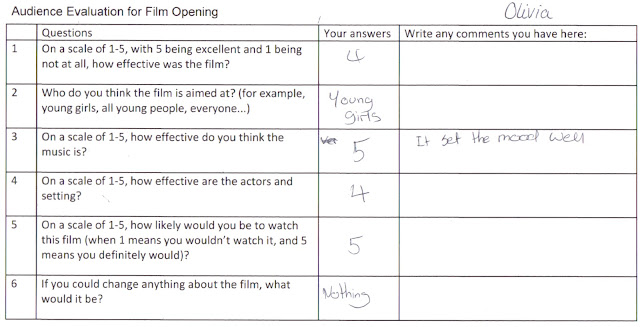
I targeted a few individuals who fitted my target audience description: Young adults, mainly girls as the film is based around girls and their relationships with each other when under strain from more mature issues. I was interested to see the response towards the film and was plesantly surprised by the amount of interest. Factors such as my deliberate decision to avoid showing the protagonist's face were commented on with positivity; this encouraged and helped me to see how my film appears to others and to become familiar with parts of it that worked well and other weaker parts of it that I can improve on or not attempt again in the future.
I used a table to allow them to evaluate my film opening after allowing them to watch it. Below is each person who evaluated my film and their response from the table they filled in:
 1. Olivia
2. Rachael

3. Shereen

I used a table to allow them to evaluate my film opening after allowing them to watch it. Below is each person who evaluated my film and their response from the table they filled in:
 1. Olivia

2. Rachael

3. Shereen
Thursday, 26 April 2012
Progression from my Preliminary Task
Looking back at your preliminary task (the continuity editing task), what do you feel you have learnt in the progression from it to full product?
When reflecting upon my Preliminary Task I see how far I have come in developing my camera skills, techniques and editing.
In my Preliminary task I only used one panning shot and the other shots were all static. In my two minute film opening I used a greater amount of moving shots to create a faster pace to certain parts of my piece.

With this shot from my preliminary task I use a panning shot to show Rachael walking all the way around the room. I feel that this shot in comparison with my other reasonably short shots is a little abnormal as it lasts for a fairly long time and created an awkward pause within the piece. If I had tracked her from a variety of different angles and maybe taken a close up of her face as she is walking I may have managed to convey a little more emotion into this piece.
In my two minute film opening I deliberately avoided showing my protagonist's face, however I used a variety of mid-shots and extreme close ups on different parts of her along with the use of voice to introduce her. I feel this is an improvement from the introduction of my characters in my preliminary task as we learn nothing about them or the tone of the situation from them from the filming or editing techniques used.

In my film opening I had a much shorter panning shot following the protagonist's feet. I feel as this shot was far shorter than my tracking shot in my preliminary task it created a much faster pace and was more effective as it would have ensured the audience attention was held.
In my preliminary task I made the mistake of cutting from a mid-shot to an extreme close-up. This created an uneasy sensation and made the film feel disjoined and prevented it from flowing smoothly. In my two minute film opening I did use extreme close ups but I built up to them by using mid-shots and close-ups beforehand to made the transition more gradual.

Throughout my filming I was aware that I needed to stick to the 180 degree rule and stay on one side of my character whilst filming at all times. This technique was something which I learned how to incorporate in my Preliminary Task and through practice it became second nature when filming my film opening.


Evaluation- Attracting and Addressing an Audience
How did you attract/address your audience?
To attract my target audience I used a young female protagonist who represents a believable person whom my audience would be able to relate to. The issues running through my film are issues which young adults often have to face in some way or another and learn to overcome in their own ways. The journey that the protagonist finds herself on is one which involves themes such as searching for identity and acceptance- an issue which all teenagers have to deal with in some form or another whils they grow in the ever-changing world.
I would use social networking sites such as Youtube, Facebook alongside with Viral Marketing to distribute my product as these are formats which young people frequently use and share media with each other. I like the technique that 'The King's Speech' distributors used when they relied on word of mouth and the timings of the release of the film to enable people to see the film and encourage viewing through positive feedback to people whom they are involved with.
Evaluation - Distribution under a Media Institution
What kind of media institution might distribute your media product and why?
After my interview with Simon Egan (producer of 'The King's Speech), it became clear from him that finding a company to distribute your film is not too challenging if the script is likable.
'The King's Speech' recieved funding from the UK Film Council; now that has closed down I would approach the BFI, which now if the funding body for British films. Now that there are new regulations about tax breaks for British films, my film is desirable as it is set and made in the UK using British actors. I may also approach Bedlam Productions for help with funding and distributing my film because of their links with Momentum Pictures.
I name a conscious decision not to name any of the roles or people involved in my film as I felt it did not follow the conventions of a Drama film with more serious tones and themes.
Below is my full interview with Simon Egan who produced 'The King's Speech', we discussed points such as how a small production company such as Bedlam managed to gain the interest of a huge institution such as Momentum pictures, along with other distribution and production issues the film faced whilst being made.
Bedlam interview
Wednesday, 25 April 2012
Evaluation- Technologies
What have you learnt about technologies from the process of constructing this product?

I have also become familiar with the use of a tripod and becoming aware of uneven surfaces whilst filming and how this can affect an image. I learned how to create a tracking shot effectively with the tripod by keeping the character within the shot and anticipating the movement of the character to keep her within the shot.
I also used the clapper board to help myself organise my shots for when I returned to them in the editing process.

I also became familiar with using a mac and the programs on it throughout my editing process. It proved fairly time-consuming at first, but once I had gotten used to certain techniques and learned some keyboard shortcuts it became much easier to edit and place my clips together in the correct sequence for my film.

I managed to learn how to cut and split clips on Final Cut Express along with using simple video and audio transitions and the layering feature. I also used more advanced features such as colour correction to make changes when the lighting in my shots was contrasting to a large degree. By using Final Cut I also learned how to import files from imovie which was extremely useful for me.

I used Livetype to create my opening credits and my production company name. This proved challenging at first but after watching tutorials to familiarise myself with the program it soon became second nature when using it.
By learning to use all these different technologies and programs I have ensured that my editing process will take less time in the future as I will already be familiar with the basic conventions that I will be using.
Tuesday, 24 April 2012
Evaluation - Target Audience
Who would be the audience for your media product?
The target audience for my film would be predominantly young adults as there would be dark themes and tones to the film which would be unsuitable for young children or family viewing. Despite the fact that the film would be suitable for adults, I feel that the target audience should be young adults as they are more in touch with the issues shown in the film.
Here is a photograph showing an example of the sort of person my film is directed towards.

Evaluation - Nine-Frame Title Analysis
In what ways does your media product use, develop or
challenge forms and conventions of real media products?
From my research into other films of the Drama genre with serious tones I had discovered fairly early on that title credits did not overlap into the film opening. By doing this it ensures the audience's attention fixed fully on the plot unfolding before whilst adding to the impact of the piece. I decided to follow this trend, and consequently kept my title credits minimal and presented them before the film actually begins. In 'The Godfather' the only title we are given is the name of the film, and in the film 'Public Enemies' we are presented with the date in which the film is set. After a fair amount of thought I decided not to show the name of the film, and just keep the credits as simple as possible by stating the name of my production company. I did not need to put a great deal of thought into the production company name as I wanted to make it personal to me. I felt that by keeping the colour scheme black and white it would create a stark contrast and hold a certain originality. The font is similar to that on a typewriter which could be tied into the typing that takes place in the opening scene of the film. The contrast of the black and white could be used to show the ideas of happiness and sadness or positivity and negativity- themes carried throughout the film.


Our next shot is yet another extreme close-up. The use of the laptop as a tool to aid the voiceover was something I feel worked well in the piece overall. It reinforces the words we are already hearing and tells us something about the nature of the character. The fact that the story is being told to nobody in person and is just being recorded in a solitary fashion shows us a reflection of the protagonist's character. She is not attention-seeking or wanting to appear brave, she is just wanting to share her story. The idea of her writing it instead of telling a group of people could also show how the events may still be fairly raw to her.

The angle of the camera changes with each shot in this scene, however the focus remains constantly on the computer and the protagonist typing. This can reflect the confusion felt by the character whilst also representing how she has tried many different approaches to solving the issue of finding her sister, reinforcing her persistent and caring nature.

The opening of the film suggests the genre mainly from the tone of the voiceover. The shots are fairly neutral, however the tone of the voiceover is serious and we hear of themes and concepts such as 'regret' which are common in the drama genre. The music used aid the voiceover in achieving its sombre tone.

Our character is first introduced by us seeing her hands. I decided from an early stage to avoid showing her face to a large degree in this particular part of the film. The voiceover tying in with the words being typed act as the protagonist's face in many senses as the film opens. The fact that we do not see her face creates a sense of guilt- which we may relate the fact that she feels she was too late to help her sister.

As the shot widens here there is more clarity to the scene we are watching. We are allowed to see a little more of our protagonist, but her face is still hidden. This is the final shot that focuses on out protagonist typing. The fact that it is wider and allows us to see more shows how she has finally reached a clarity of mind and has come out of her state of confusion throughout her journey in the film.

This next shot shows a setting which we are to see later on in the film. The voiceover is still reflecting on her journey, so we are now taking a step back to see not just the person who has journeyed through hardships, but the settings in which some of the key events would have taken place. This shot allows us to almost look into the protagonist's memories themselves.

The shot of the bird is mainly observational, however it could show how the protagonist is spreading her wings and allowing the burden of her guilt to be lifted from her.

The church shot shows a loss of faith- not a direct religious loss of faith- but the challenges of losing faith in yourself. This is something which the film does tackle and is eventually resolved in the end.
Thursday, 19 April 2012
Evaluation - Representation of Social Groups
How does your media product represent particular social groups?
In my film opening the focus is directed towards a young protagonist in her late teenage years. In the film she is faced with trying to find her younger sister, Tasha, who has gone missing due to becoming involved in drug usage and peer pressure. The older sister- our protagonist- has to face her own issues to try to find and help her sister overcome hers. Issues such as loss and the struggle of dealing with things we cannot change in life and the hopelessness that this brings are just some of the challenges this young teen has to face throughout the film.
 Across the drama genre, teenagers are faced with many challenges and issues such as: drug usage, peer pressure, school and social circles, leading double lives behind the backs of their parents.
We can see examples of teenagers struggling to overcome these issues in films such as Adulthood which focuses on young adults involved in gangs, violence and drugs. This reflects the frequently held perception by many that teenagers are troublemakers and that the reasons for their faults and attitudes are reliant on not just society but upbringing and friendship circles. This is something that is relatable to the character of the younger sister in my film opening.

Another different representation of teenagers is within the social circles of school life and the stereotypes that young people are labelled with. In films such as St Trinians we see examples of these firm social circles and stereotypes being used in relation to teenagers. The stereotypical 'reckless youngster' is something which I incorporated in the character of the younger sister. Even though we do not see Tasha in the opening of the film, the fact that she has gone missing reflects the rash side of teens and how they can become wrapped up in a situation that is far bigger and more dangerous than they first may percieve it to be.

Subtle uses of setting is something I used to subliminally suggest the darker tones of the film. There are two locations in the small montage that show our protagonist going through first an alleyway and then a tunnel with graffiti on the crumbling walls. The fact that the protagonist strides boldly through the tunnel, ignoring the intimidation of the darkness and the threat of who could be nearby shows that she has the strength of character to not allow herself to become caught up in that area of teenagehood. This makes her a contrast to her younger sister who has fallen prey to this.

In the film 'Children of Men' the protagonist may not been a young adult faced with exactly the same issues, but he is dealing with an issue that involves a risk and a character changing journey- similar to the protagonist in my own film opening. Both characters are relatively ordinary looking, their clothes are normal and relatively plain which represents the neutral side of them. Both however speak in serious tones and show little humour, this represents their strength of character and their focus on the task they are trying to follow.

Tuesday, 6 March 2012
Opening Credits Research
I have been researching what sort of opening credits to include in my film opening. Through looking at films of a similar genre it has come to my attention that in more serious and classic films, there are far fewer credits and they rarely overlap into the actual film sequence as typical modern films do today.
Examples of this are in 'The Godfather' where the only credits are 'Paramount Pictures Presents' followed by 'The Godfather' on a black screen before the film truly begins. In the 'Moulin Rouge' the only credits are 'Twentieth Century Fox Presents' , 'A Bazmark Production', 'The Moulin Rouge!' followed by the date in which the film is set: 'Paris 1900'.
Opening Credits that I have listed to consider putting into my film opening are: 'Director of Photography', 'Directed by', 'A Laughing Magpie Production', 'Film name'. Along with the names of my actresses.
 None of these opening credits continue into the actual film itself. I feel that this is perhaps typical in films starting with a more serious or sad theme as credits overlapping the shots would take the focus and power away from the opening scene and take away from the impact it is supposed to have on the audience.
Examples of this are in 'The Godfather' where the only credits are 'Paramount Pictures Presents' followed by 'The Godfather' on a black screen before the film truly begins. In the 'Moulin Rouge' the only credits are 'Twentieth Century Fox Presents' , 'A Bazmark Production', 'The Moulin Rouge!' followed by the date in which the film is set: 'Paris 1900'.
Opening Credits that I have listed to consider putting into my film opening are: 'Director of Photography', 'Directed by', 'A Laughing Magpie Production', 'Film name'. Along with the names of my actresses.

Friday, 2 March 2012
Practice Shots.
In this video I practiced shooting some of the shots that were going to be in my two minute film opening. I practiced following pacing feet, and used a spot so that I would know where they would stop walking. I also tried slowing down a shot of the phone falling to see what effect this gave. Most of these shots I don't like, but it proved very helpful to practice filming them so that I could work out what would be more difficult and what I may need to film later on.
Thursday, 9 February 2012
Practice Shots
Here I tried a few different practices of shooting some of the shots that I will be using in my film opening. I practiced following the feet as they paced, trying to keep the camera ahead of the feet as they moved so it lead them onwards. When shooting the section where the pacing feet turn to face the camera I placed a small spot on the floor to mark where the feet would stop. It was still difficult for me to keep the feet in the whole shot but I worked on practicing the camera movement to improve this. When filming this, the camera was on the tripod about 40cm from the ground. I also plan on seeing whether these shots would be more effective if I had the camera on the floor at the same level as the feet.
When filming the hands typing I first had the shot simply focused on the hands and they keyboard. In the second clip that I shot of the hands typing I tried getting a small section of the computer screen into the foreground of the shot to create a sense of depth. I feel that this second shot worked better as I had something in the foreground of the shot.
In the clip where the shot in focused on the computer screen the shot is moving slightly. I feel this may have been because of the fact that the camera was not securely fixed to the tripod when I was filming this. If the shot still does not work then I will see whether it is better if the shot is a little less zoomed in.
Wednesday, 1 February 2012
Script
I had started drafting up a script for the speech and the voiceover used in the opening of my film.
The Opening Voiceover:
We all do things that we regret. Like the day we leave something behind. We aren’t always aware of doing such things until time has decided the outcome. Sometimes those who try the hardest are the ones that lose the most. Those who try the hardest are often those who care the most, and from their deep love they strive with every fibre of their being to resolve the issues they cross in life – to build the bridges. But bridges eventually crumble when what supports them is taken away.
Sometimes, by trying our hardest to see something, the answers elude us. We are unaware however, that they can be beneath our nose the whole time.
The One-Sided Phonecall:
*Phone rings*
Sibling: Hello?
…..
Sibling: …….Well what do you mean, ‘she’s missing’?
…………
Sibling: *More rushed*……No, not this week. ……No, I haven’t spoken to her since then….
…….
Sibling: ……Yes. ……I don’t know…..She wouldn’t want them to know.
……….
Sibling: *Frustrated* Well it’s not my fault she got herself in this mess! ………..-- Yes, of course I care, you know I care!
……….
Sibling: Then don’t talk like that. She can’t be far…..Probably just ran off.
……………..
Sibling: Well there’s not much you can do! Yes. Okay—Yes. I’m going to look for her. Look—Yes, of course she will be.
*Hangs up*
Wednesday, 14 December 2011
British Films and King's Speech Case Study
I have done some research on what makes a British film, I used an example, The King's Speech as it is a Drama film. I thought it would be helpful to look at a British drama film in detail and the production that went into it as it could help me with my own drama film.
British films
View more presentations from AnnabelleD.
Monday, 5 December 2011
Nine Frame Analysis of the Opening Scene of 'Public Enemies'


The shot then changes to the hands of the prisoners, we still do not see their faces in the shot, this helps us to question who is being arrested, possibly. Or the fact that we cannot see the faces of the people reflects how they are not seen as people. They are all dressed the same, in the same position and doing the same thing. The only thing that defines them as individuals is their face and this is the very thing that is hidden from the audience.


At this point we finally see the faces of the prisoners marching by. The camera angle has changed, and the shot is still close up. The focus throughout all of the frames so far has been wholley on the prisoners, nothing else. Their expressions are firm and so far no music has been played in the film. Music could have had a large impact and influence on how we view the prisoners at this point in the film. If sad music was played, we may feel empathy or sympathy for them, perhaps leading us to thing they are not deserving their sentence. If menacing, dark music had been playing we would perhaps think these people were evil and deserved the treatment they were getting. As there is no music we cannot help but to take a neutral standpoint on the prisoners, and as we see later on in the film, this is for a good reason.

We now have our first shot that is not purely focused on the prisoners. A guard is watching them pass by, and the shot previous to this one could have been following his eyeline to what he was seeing as the angle of the prisoners walking by matches the position he is standing in beside them. The shots are still close ups, not allowing us much scope to see the conditions or setting, although from the people we have seen we are lead to believe it is a prison. This is interesting, as we are told the surroundings not by being shown a large prison building, but by seeing the people, what they are wearing and the way in which they behave.

A wider shot now allows us to see a fallen prisoner, this is a short, yet powerful shot. It can tell us much about what the prisoners are going through and the conditions. It is quite amazing how such a short shot can tell us so much. We also see that nobody is paying any attention to this fallen prisoner. The prisoners marching do not appear to be even looking at him, and the guards are paying no attention to him, either.


We then return to a cluse up shot of the hands of the prisoners. Once again I feel that if music were used this could create a strong feeling of how we view these people. Hands can show a huge amount of emotion. This image could show the weakness of the prisoners, or it could show their anger and how they wish to break free again.

Saturday, 3 December 2011
Title Sequence Timeline of 'The Moulin Rouge'
I analysed the opening scene of the Moulin Rouge by putting into a timeline. I think this will be very helpful when I am planning my own film, as the timeline allows me to see how shots change and how fast they change. They really help you to see the style of the director of the film and highlight some interesting techniques that you make not otherwise notice unless you take the film apart into such small details.


Friday, 2 December 2011
Iconic Sounds
I am extremely fond of classical music being used in films. I find it can evoke a great deal of emotion and sets a subtle mood. Sometimes, when used effectively, you are not even aware that there is music playing in the background of a film.
I find that using classical numbers will help set the more sombre tone to my piece. I am very fond of Elliot Goldenthal's work. He has done the soundtrack for the Crime Drama Public Enemies, I find the pieces composed for this film are extremely powerful and I would like to use similar music to this if I choose to use music in my task.
As I am also fond of Film Noir, I have a soft spot for typical 1930's singers, too. I love Billie Holiday's music, and find her style is also powerful as her voice carries a great deal of emotion and passion when she sings.
In the film Pride and Prejudice, I find the classical music is some of the best I have ever heard in a film. My favorite piece from the film has to be 'Liz on top of the World'.
Another song which I find deep and emotive is Cold by Aqualung & Lucy Schwartz.
Typical Synopsis
As I have mentioned in my previous posts, the Drama film genre is very broad. It contains many sub-genres, some of which I am going to write about here. I am hoping that by summarising some of the sub-genres of Drama films, I will be able to decide which sub-genre of Drama I would like to use in my film opening.
 A style of film which I have a passion for is Film Noir, I find that fact that it is in black and white is not just original but also helps give an overall mood to the film, I am quite fixed on trying to make the opening of my film in Black and white, too. I find that the darker tones will show connotations of the mood I am trying to reflect in my film, I am quite keen on a sombre tone. Film Noir is not really a genre of film, but it is a kind of film that has a very strong emotion and tone to it, something which I would like to try and create myself. The film often uses dark images and silhouettes, something which I find very effective in creating emotion and a tone in a film.
 These are sub-genre of Drama films. These often incorporate unrealistic characters dealing with romance or domestic issues with characters that came under certain stereotypes. These kinds of films are made to appeal predominantly to female audiences. They are often described as 'tear-jerkers', 'woman's films' or even 'chick flicks'. An example of a Melodramatic film is 'A Time to Love and a Time to Die' which is about romance during the war time.

Whilst browsing, I found the page on the same website that I posted previously which is very helpful when looking into sub-genres as it is easy to read. http://www.filmsite.org/subgenres.html
 A style of film which I have a passion for is Film Noir, I find that fact that it is in black and white is not just original but also helps give an overall mood to the film, I am quite fixed on trying to make the opening of my film in Black and white, too. I find that the darker tones will show connotations of the mood I am trying to reflect in my film, I am quite keen on a sombre tone. Film Noir is not really a genre of film, but it is a kind of film that has a very strong emotion and tone to it, something which I would like to try and create myself. The film often uses dark images and silhouettes, something which I find very effective in creating emotion and a tone in a film.
Melodramas
 These are sub-genre of Drama films. These often incorporate unrealistic characters dealing with romance or domestic issues with characters that came under certain stereotypes. These kinds of films are made to appeal predominantly to female audiences. They are often described as 'tear-jerkers', 'woman's films' or even 'chick flicks'. An example of a Melodramatic film is 'A Time to Love and a Time to Die' which is about romance during the war time.
Biopics
Another sub-genre of Drama. Biopics focus on the life of a person or group of people, telling their story. Sometimes the people focused on in these films are famous people, and the film will tell their story. The word 'Biopics' is combinationg of 'Biography' and 'Pictures'. Biopics can fall under many film genres, not just Drama. An example of a Biopic is Ron Howard's film 'A Beautiful Mind' which focuses on the life of a schitzophrenic. This sub-genre appeals to me, as I feel that I would like to focus on just one person in my film opening. I want my film opening to be serious, and to draw the auidience in, something which I think a film under this sub-genre will achieve very effectively yet subtely.
Romantic Dramas
A very large sub-genre of Drama is Romance. These films generally focus on the struggles of two people in love to be together and their journey as a couple, facing certain issues together. The romantic films that fall under the Drama category can often end in tradgedy, the happier Romance films often come under the Comdey or Chick Flick genre.
Supernatural Films
Perhaps a less obvious idea of a sub-genre of Drama films. But horror films and other similar films use a great deal of suspense to build up an emotion of uncertainty or fear in the audience. By making the audience feel frightened, the film must be effective as to be afraid, you have to be able to connect with the film and it needs to be believable to some degree. To do this I believe it is a great skill, which does use some dramatic effect. Many of these films are filmed using handheld cameras, such as the Blair Witch Project, Paranormal Activity and Cloverfield, all of which are quite sucessful or controversial. As I am also going to be filming my film opening with a handheld camera I feel that perhaps by looking at the techniques used in these films I will find an effective way of creating suspense in my own film. These films have proved that you do not need advanced equipment to make a successful film, it's about how you use what you have in an intelligent and new way that the audience is not used to. These films are extremely clever as they use no digetic sound or music over what the characters are hearing, this makes it hard to tell when something will happen as in more conventional horror films you will hear music building up to an event to scare us.

After looking at these sub-genres of Drama films I am keen on trying to make a Biopic film, following the life of somebody in a darker light, perhaps incorporating some of the techniques from other sub-genres that appeal to me. I will look at techniques used by supernatural films using handheld cameras to build suspense and to gather ideas that I like from them that I may like to try and use in my own film. I will also look closely at techniques used in Film Noir as this is my favourite style of film due to it's originality and tone.
Whilst browsing, I found the page on the same website that I posted previously which is very helpful when looking into sub-genres as it is easy to read. http://www.filmsite.org/subgenres.html
Thursday, 1 December 2011
Audience Expectations!
Interviews with the Audience
Here are some interviews with my target audience on what they think a drama film is all about and what they would expect to see in one.
Just from interviewing these people it is clear how many sub-genres Drama contains as many different themes were brought up, such as: war, romance, crime and death.
It is clear from most of the interviews that some form of strong emotion or conflict is a key theme in a film that comes under the drama genre.
Tuesday, 29 November 2011
Conventions and Trends of the Drama Genre
Drama is a very broad genre with a great deal of sub-genres within it. Despite this, there are still certain conventions that are a running trend throughout a great deal of films that come under the Drama genre.
- The characters in the films tend to be more serious and believable, as opposed to large characters that are blown out of proportion for comical or other reasons.
 The protagonist is often after a object, person, or state of mind. There is generally always some kind of aim of the characters or problem they have to face.
- The music used is often sombre in tone, and classical as opposed to more popular pop songs. If songs with words are used, they tend to describe how one of the characters is feeling at that particular point in time. The music is key in drama films, it sets the tone for the scene and gives it a depth that the audience can connect with on another level.
- Many Drama films start at the ending of the film, showing us how the character is at the end of the story. The film then goes back to show the previous events that landed the character in their current situation.
- When films begin at the endings, they often show a character as being defeated and sad, then we go back to see what caused this.

Reference: http://www.filmsite.org/genres.html
Whilst looking up common conventions and trends of the Drama genre I also stumbled across another website with a good definition: "Conflict is the essence of drama, and the purpose of a dramatic storyline is to move or touch the audience in some emotional way. There is usually a struggle going on that is wrought with hardships, difficulty and pain… Dramas are generally serious stories depicting life situations in a realistic way with characters behaving at their worst and at their best.” Reference: http://encyclopedia.jrank.org/articles/pages/3080/Film-Genres.html
Subscribe to:
Posts (Atom)